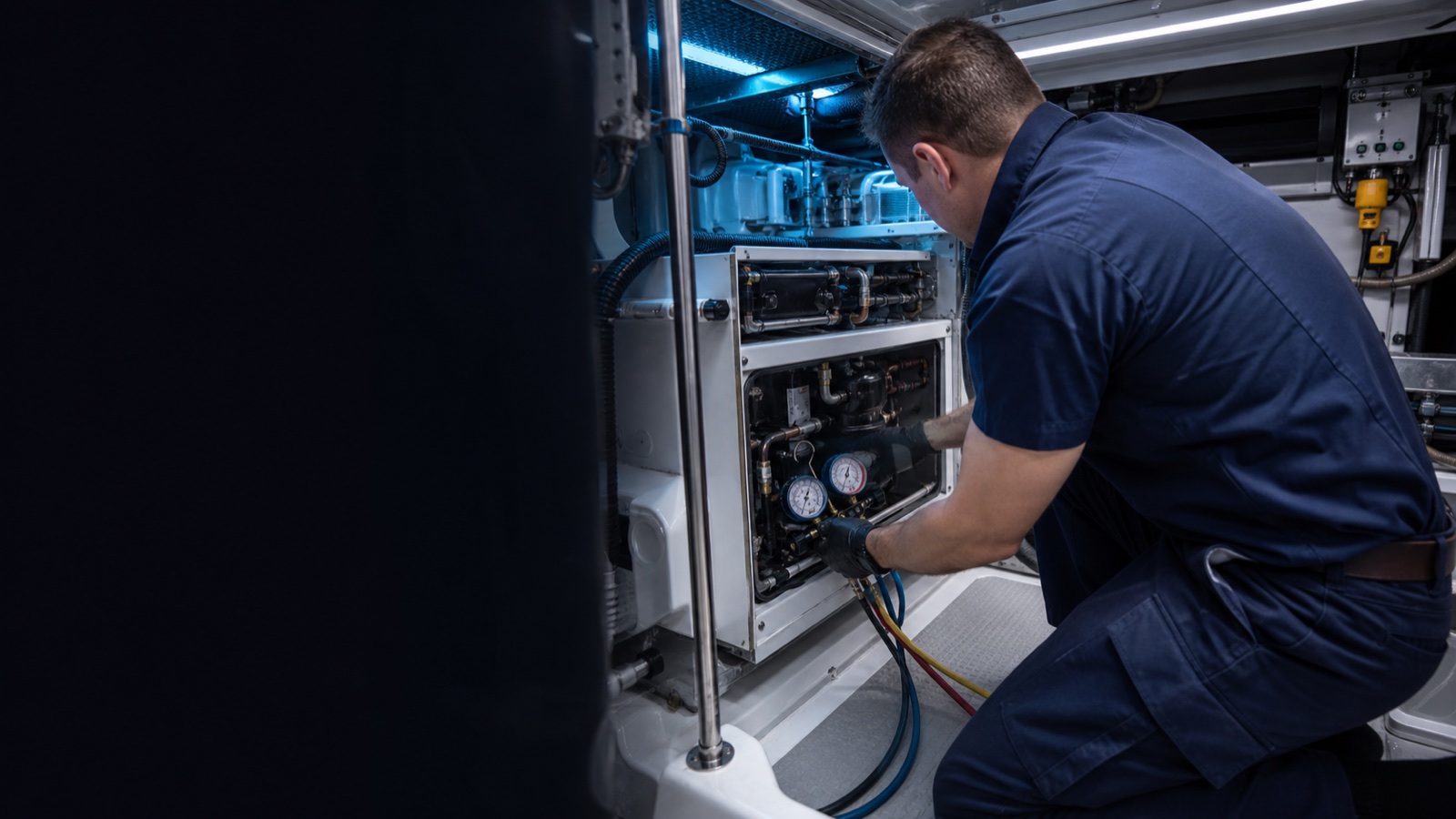
A marine air conditioner does not need replacement simply because it is old, and a repair is not automatically the economical choice because one part can be changed. The useful question is whether the complete system can deliver reliable comfort for the vessel's intended use after the proposed work.
Begin with a confirmed diagnosis
Replacement discussions should follow testing, not precede it. Restricted seawater flow, poor cabin airflow, a sensor issue or a loose electrical connection can imitate a major equipment failure. Ask what was measured, what component or condition failed and what evidence supports the recommendation.
If cooling performance is the concern, our guide to a boat AC that is not cooling explains the main system paths a technician may evaluate.
When a focused repair may make sense
- The fault is isolated and the rest of the system is in sound condition.
- The correct part is available and appropriate for the equipment.
- Coils, cabinet, wiring and water connections are not showing broader deterioration.
- The system previously met the vessel's cooling needs.
- The repair can be tested under realistic operating conditions.
A quality repair recommendation should define the work, explain what is not included and set realistic expectations. It should not promise that an unrelated aging component can never fail later.
When replacement deserves serious consideration
- A major component has failed and the remaining equipment is substantially deteriorated.
- Refrigerant leaks are repeated or located in components that are impractical to repair.
- Critical parts are obsolete or difficult to support.
- The system is poorly sized, excessively noisy or no longer suits how the boat is used.
- Corrosion, prior modifications or recurring faults make future reliability uncertain.
Replacement is a vessel project, not a box swap
Marine equipment must fit the available space and work with the vessel's electrical, heat-rejection, duct and condensate systems. Capacity, voltage, startup demand, control compatibility, service access and physical dimensions all matter. An apparently similar unit may require changes around it.
Ask how the proposal addresses removal and access, electrical protection, air-system interfaces, duct transitions, condensate management, controls, startup testing and owner orientation. If cabinetry or other trades are needed, identify responsibility before work begins.
Compare the complete decision
Instead of comparing only the repair invoice with the equipment price, compare expected outcome, downtime, parts support, installation scope and confidence in the remaining system. For a boat used for long trips, predictability may carry more weight than it does for a vessel that stays near its base marina.
Plan the next step
Gather equipment-label photos, service history, fault codes and a description of how the boat is used. Knot Hot can evaluate marine air systems across its South Florida service area. Use the service request form to share the vessel and marina details.